
Sports Turf Renovation & Maintenance: Reviving a Worn Ground
Elite Turf Projects renovates and maintains natural turf sporting surfaces for councils, clubs and schools across Sydney and Western Sydney.
A sports field that once played true can slip into disrepair a season at a time. Compaction spreads from the goal mouths and the centre wicket, drainage slows, the sward thins along the divot lines, and levels drift until a rolling ball no longer runs true.
That decline is more than cosmetic. It is a player-safety issue, a wet-weather cancellation risk, and a growing bill the longer it is left. This guide walks through how to read the signs a ground needs work, what a proper renovation involves, and how a sensible maintenance program keeps a surface performing between major works.
Signs your sports ground needs renovation
Grounds rarely fail overnight. They degrade gradually, and the early warning signs are easy to write off as normal wear until a wet Saturday forces a cancellation.
Compaction takes hold
Hard, worn ground spreads from the goal mouths and the centre wicket, where foot traffic concentrates.
Drainage slows
Water sits on the surface after rain and the ground stays wet long after play should have resumed.
The sward thins
Grass cover breaks up along the divot lines and worn tracks, leaving bare, uneven patches.
Levels drift
The surface loses its plane through settlement and wear until a rolling ball no longer runs true.
One or two of these can often be managed within a maintenance program. Several together, or a surface that keeps sliding backwards despite regular care, usually means it is time for a planned renovation.
The sports turf renovation process
Renovation is not a single job, it is a sequence of works run in the right order and matched to the ground. A good contractor assesses the profile first, then builds a scope around what the surface actually needs. It follows the same layered logic as new sports field construction, applied to a surface that is already in play.
Aeration and decompaction
Almost every renovation starts here, because compaction is the root cause of most surface problems. Aeration opens channels through the profile so water, air and nutrients reach the root zone again. Depending on severity, that ranges from hollow-tine coring, which removes plugs of soil and lets you follow up with fresh material, to solid-tine or deep-tine work that fractures the profile further down.
Topdressing with the right sand or soil
Topdressing is where material quality makes or breaks the result. A thin, even layer of the correct sand or sports-soil blend is spread over the surface and worked in, smoothing minor irregularities, diluting thatch, and, over successive applications, improving the drainage and firmness of the whole profile. The critical word is right: the sand grading and any soil blend must suit the existing profile.
Oversowing and seed selection
Oversowing reintroduces vigorous, desirable grass into a thinning sward. The species and cultivar are chosen for the sport, the climate and the level of wear, because a heavily used winter football field has very different needs from a cricket outfield or a school oval. Good seed-to-soil contact matters, which is why oversowing is timed around aeration and topdressing rather than done in isolation.
Laser grading and levelling
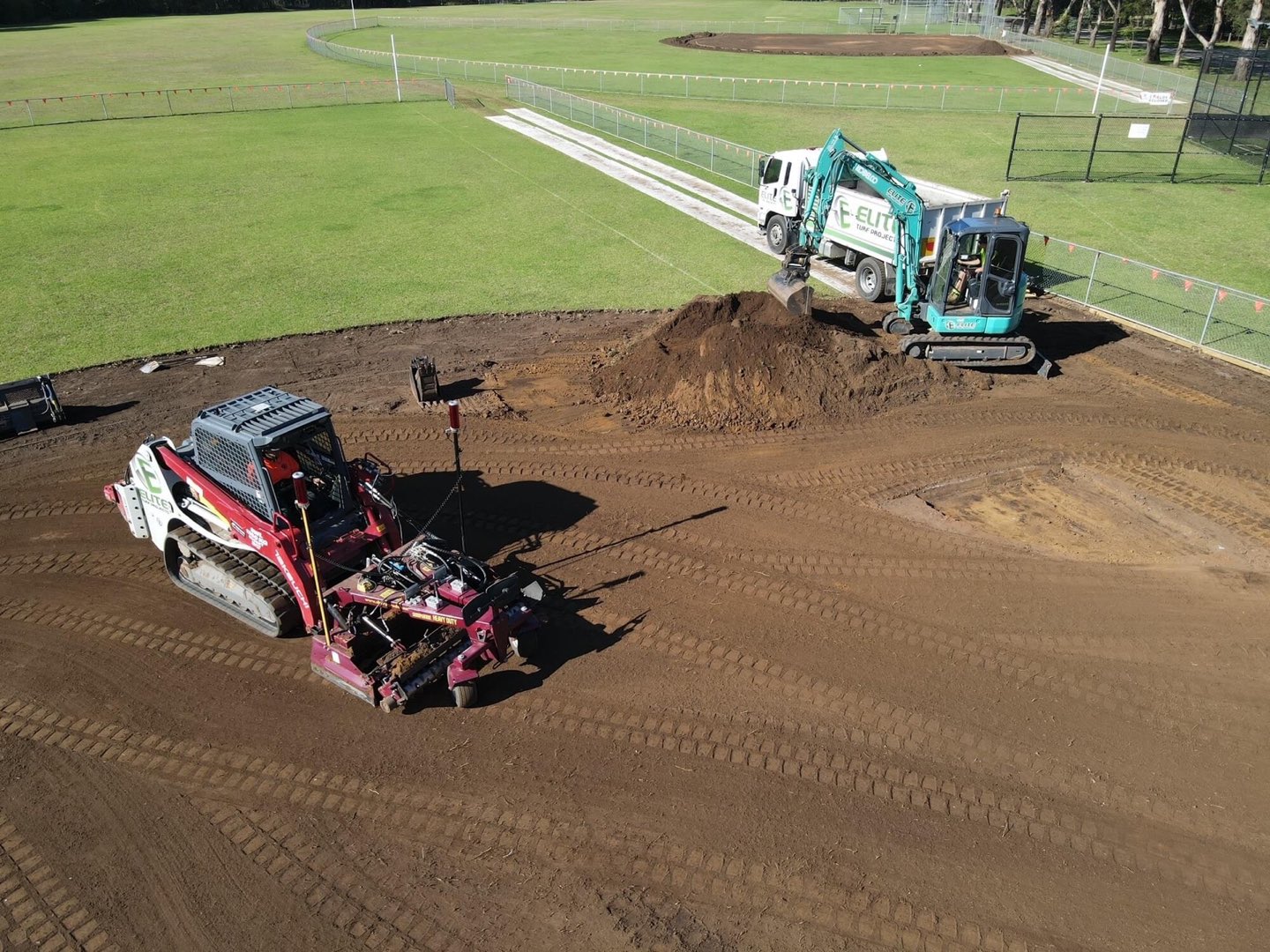
Where a surface has lost its plane, laser grading restores a true, safe playing surface. This is more involved than topdressing and is used when undulation, poor falls or historic settlement start to affect play or drainage. Correcting levels also makes every future maintenance pass, from mowing and marking to irrigation coverage, more effective.
Fertilising, weed control and finishing
A renovation finishes with a considered nutrition and weed-control program so the new and existing grass has what it needs to knit together and recover. The aim is a surface handed back with a clear plan for the establishment period, not one left to fend for itself.
How the operations fit together
The sequence matters as much as the individual works. Each operation targets a specific problem, and they reinforce each other when run in the right order.
Aeration
Relieves compaction so water, air and nutrients move freely to the root zone again.
Topdressing
Smooths the surface, dilutes thatch, and lifts drainage and firmness across the profile.
Oversowing
Thickens a worn sward with grass matched to the sport and the level of wear.
Laser grading
Restores a true, safe plane where the surface has settled or lost its falls.
Fertilising and weed control
Feeds the recovery and stops weeds filling the gaps while the grass knits together.
Why topdressing material matters, and the Elite Group advantage
The single most common way a renovation underdelivers is the wrong topdressing material. Sand that is too fine, a soil blend that does not match the existing profile, or inconsistent grading between batches will undo careful aeration and oversowing. Because Elite Turf Projects is part of the family-owned Elite Group, alongside Elite Sand & Soil, the sands and soil blends come from the same group that carries out the works.
Matched to the profile
The sand grading and any soil blend are chosen to suit the ground in front of us, not a generic mix.
Consistent between batches
The same specification supplies every topdressing pass, so results do not drift from one application to the next.
Supplied in-house
The sands and soil blends come through Elite Sand & Soil, part of the same family-owned Elite Group.
Sports turf maintenance programs
Renovation resets a surface; maintenance keeps it there. A structured turf management program spreads the smaller, regular works across the year so a ground never drifts back into the disrepair that made renovation necessary.
Mowing and marking
Cutting to the right height for the sport and season, with clean, accurate line marking.
Scheduled aeration
Regular relief of compaction before it takes hold and starts to shed grass cover.
Topdressing and feeding
Light, routine applications that keep the surface true and the sward well nourished.
Weed control
Keeping weeds out so desirable grasses hold the surface through the playing season.
Irrigation checks
Confirming even coverage so the ground neither dries out nor holds water in patches.
Renovation planned in
Booking the larger works into the calendar rather than waiting for a surface to fail.
The point of a program is that it is planned, not reactive. A ground kept to a schedule holds its condition, needs renovation less often, and rarely surprises you with a closure on a big fixture weekend. See the full range of services Elite Turf Projects offers.
Seasonal timing: when to renovate a Sydney sports ground
Timing is one of the biggest factors in how well a renovation recovers. In Sydney's climate, most sports grounds grow on warm-season grasses such as couch and kikuyu, which do their strongest growing through the warmer months. Major renovation works best when the grass is actively growing and can knit back together quickly, broadly from spring into early summer, so aeration, topdressing and oversowing recover fast.
The other half of the equation is the playing calendar. Winter-sport fields are usually renovated in the off-season once the competition finishes, which gives the surface a clear window to establish before pre-season. Summer-sport surfaces are planned around the reverse. The workable dates shift year to year with the weather, so the practical approach is to book an assessment ahead of your off-season and let the ground and the forecast set the start date.
Talk to Elite Turf Projects.
If a ground you manage is showing the signs above, the first step is an honest assessment of the profile and a scope built around what the surface actually needs. Send the details and the Elite Turf team will walk the ground and talk it through.